 Veteran owned business

Blog
7 Boat Gel Coat Maintenance Schedule Steps That Protect Your Hull
Nov
Last Updated: November 24, 2026
Quick Summary
Wash every two to four weeks during the season, do full spring and fall checkups, and wax every three to four months in high-exposure climates. This gel coat maintenance schedule should be adjusted for sun exposure, saltwater versus freshwater use, and covered or open storage.
- Wax every two to three months in intense sun and heat, and add a mid-season polish on the bow and topsides.
- Rinse with freshwater after every saltwater outing, since salt crystals are abrasive and hold moisture against the surface.
- Wax twice a year is usually enough for covered or indoor storage, but check monthly for condensation staining.
- Spray water on a clean section: if it beads and rolls off, protection is holding; if it sheets and soaks in, re-wax.
- Polish oxidized areas before waxing, because waxing over oxidation traps the chalky layer and looks worse within weeks.
Table of Contents
- Why a Gel Coat Maintenance Schedule Beats Reactive Repairs
- Assessing Your Gelcoat Condition Before You Choose a Treatment
- Your Season-by-Season Gel Coat Maintenance Schedule
- Boat Gel Coat Waxing Schedule: How Often and Which Product
- How to Fix Gel Coat Scratches and Waterline Stains
- When to Use a Boat Gel Coat Restoration Kit
- Boat Gel Coat Touch Up: Small Repairs Between Full Restorations
- Choosing Your Maintenance Supplies from Marine Coat One
- Frequently Asked Questions
Why a Gel Coat Maintenance Schedule Beats Reactive Repairs
A boat gel coat maintenance schedule is a written plan for washing, inspecting, polishing, and sealing your hull on a set timeline instead of waiting for damage to appear.
Reactive repair costs more. That’s the core tension here. A chalky, oxidized surface needs polishing and sealing. A cracked or gouged one needs filling, sanding, and color matching.
Gelcoat is the pigmented resin layer that gives a fiberglass hull its color and shine.
That distinction runs through this entire guide.
Assessing Your Gelcoat Condition Before You Choose a Treatment
Before you buy a single product, look at the surface honestly. The treatment you pick depends entirely on which stage of wear you’re looking at, and skipping this step is the most common mistake we see.
Start with a clean, dry section of hull in good light. Run your hand across it. Then check for these signals:
- Chalky residue on your fingers after touching the surface
- Dull patches that don’t reflect light evenly
- Faded color compared to areas under cover
Reading the Four Stages of Gelcoat Wear
We group gelcoat condition into four stages, because each one calls for a different response:
| Stage | What You See | Treatment |
|---|---|---|
| Healthy | Even gloss, color holds | Wash and wax on schedule |
| Oxidized | Chalky, dull, faded | Polish, then seal |
| Stained | Waterline and scuff marks | Targeted stain removal, then wax |
| Damaged | Cracks, chips, deep scratches | Repair, then restore |
Most boats sit somewhere between stage two and three. That’s normal. What matters is catching the transition before it becomes stage four.
Your Season-by-Season Gel Coat Maintenance Schedule
Here’s the short answer most boat owners are searching for: wash every two to four weeks during the season, do a full spring checkup, do a full fall checkup, and wax every three to four months in high-exposure climates. But that baseline only works if your boat lives in average conditions. The schedule that actually protects gelcoat is built from three variables: how much sun the surface sees, whether the boat sits in saltwater or freshwater, and whether it is stored covered or open to the weather.
Start With Your Exposure Profile
Before you copy any calendar, classify your boat on these three axes. Most owners land in one of four profiles, and each one shifts the intervals below.
- High-sun, open storage: hull faces direct UV most of the day, no cover between outings. This is the fastest-oxidizing profile.
- Saltwater, in-water slip: constant salt film, waterline growth, and spray exposure. Rinsing frequency matters more than wax frequency here.
- Freshwater, trailer or lift: lower salt load but repeated launch and retrieve cycles expose the hull to grit and road film.
The Baseline Annual Calendar
Use this as the starting point, then adjust using the profile rules that follow.
| Timeframe | Task | Frequency |
|---|---|---|
| Each outing | Freshwater rinse, especially after saltwater use | Every use |
| In season | Full wash with mild soap and soft mitt | Every 2-4 weeks |
| Monthly | Inspect hull, deck, waterline, and fittings | Monthly |
| Spring | Full wash, polish oxidized areas, wax, hardware and sealant check | Once |
| Mid-season | Re-wax high-sun areas (bow, topsides, south-facing hull) | Once |
| Fall | Deep clean, waterline stain removal, protective coat before storage | Once |
| Winter | Cover or store, inspect monthly for moisture and staining | Ongoing |
Adjusting the Calendar by Climate and Storage
- Intense sun and heat: move waxing to every two to three months, and add a mid-season polish pass on the bow and topsides where UV hits hardest. Water beading is your check; when it stops beading, the protection is gone regardless of the calendar date.
- Saltwater exposure: rinse after every outing, not just weekly. Salt crystals are abrasive and hold moisture against the surface. Add a waterline wipe-down every two weeks during heavy use.
- Freshwater and trailer use: road film and launch grit are the main enemies. Rinse the hull and trailer contact areas after each retrieve, and inspect the keel and chine for scuffs monthly.
Monthly and Biweekly Washing Routine
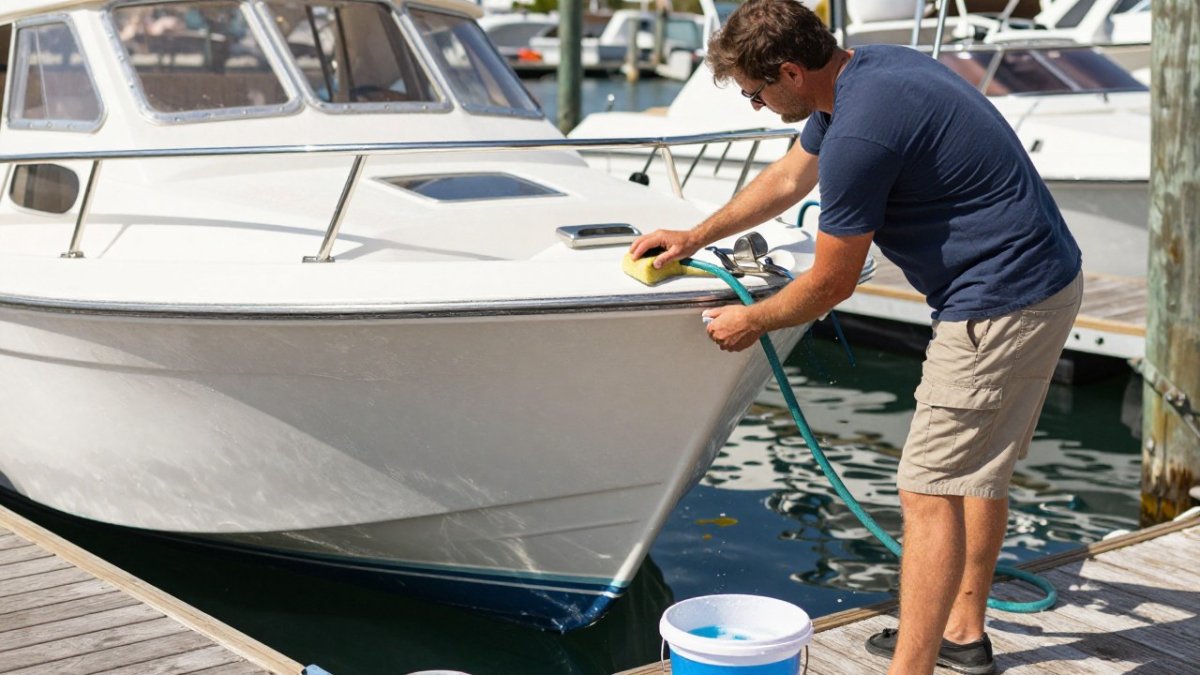
Regular washing does most of the heavy lifting. Salt residue, grit, and bird droppings all break down the finish if they sit.
Use a mild soap. Rinse with fresh water before you scrub, so loose grit lifts off instead of grinding into the surface.
- Rinse top to bottom
- Wash with a soft cloth or non-abrasive sponge
- Pay attention to the waterline
Watch out: washing in direct sun lets soap dry on the surface and leave film, so work in shade or rinse each section before moving on.
Spring Checkup and Fall Checkup Tasks
Spring is about undoing winter. Fall is about preventing it.
The spring checkup covers a full wash, a polish pass on any oxidized areas, a fresh coat of wax, and a close look at fittings and hardware for corrosion.
If you’re weighing DIY against paying a yard, our guide on whether gel coat repair is worth doing yourself covers the trade-offs directly.
Time and Effort by Task
Planning is easier when you know what each task actually costs in hours.
Boat Gel Coat Waxing Schedule: How Often and Which Product
Wax every three to four months in high-sun climates, and twice a year in milder ones with covered storage. That’s the boat gel coat waxing schedule we recommend as a baseline. In the high-sun, open-storage profile, shorten that to every two to three months, and add a mid-season refresh on the bow and topsides where UV hits hardest.
The product matters as much as the timing. Here’s how the main options compare:
| Product Type | Protection Window | Best For |
|---|---|---|
| Natural paste wax | 2-3 months | Show boats, easy application |
| Synthetic marine wax | 3-4 months | General use, strong UV block |
| Polymer sealant | 4-6 months | Long storage, low maintenance |
Protection Window
Prep Order: Clean, Polish, Then Protect
Wax is the last step, never the first. The order is wash, remove stains, polish oxidized areas, then apply wax or sealant. A common mistake is waxing over oxidation. Wax traps the chalky layer instead of removing it, and the surface looks worse within weeks.
Watch out: applying wax over a surface that still has cleaner residue prevents proper bonding, so rinse thoroughly and let the surface dry before the first coat.
Application Mechanics That Affect How Long Protection Lasts
How you apply matters as much as what you apply. Thin, even coats are generally easier to buff cleanly than thick ones, because thick wax can haze unevenly and trap dust. Work in shade, apply in small sections, and buff before the wax fully cures. On non-skid, skip wax entirely; it fills the texture and creates a slippery surface.
Product Compatibility and What to Avoid
- Match the product to the surface: waxes and sealants are for glossy gelcoat; non-skid gets cleaners only.
- Avoid dish detergent and harsh degreasers for routine washing, since they strip protection.
- Do not layer sealant over wax without stripping the old coat first; the sealant will not bond evenly.
Checking Whether Protection Is Still Working
To check whether protection is still working, spray water on a clean section. If it beads and rolls off, the coat is holding. If it sheets and soaks in, it’s time to re-wax. Check monthly during the season, and always before a long storage period.
How to Fix Gel Coat Scratches and Waterline Stains
Light scratches and waterline stains are the two problems boat owners ask us about most. Both are fixable at home with the right approach, and neither requires a full restoration.
For waterline staining, start gentle and work up. A non-abrasive cleaner and soft cloth remove most organic stains.
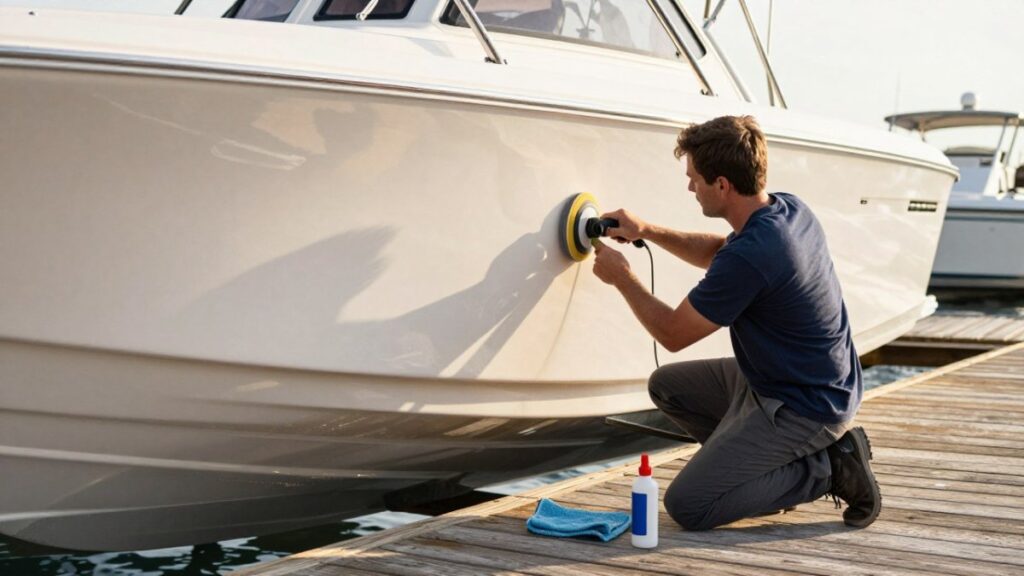
For shallow scratches, clean the area, apply a fine polishing compound with a soft cloth, and buff in small circles. For a full walkthrough, see our step-by-step guide on how to fix gel coat scratches.
Watch out: buffing too hard in one spot burns through the gelcoat and creates a bigger repair than the scratch you started with.
When to Use a Boat Gel Coat Restoration Kit
A boat gel coat restoration kit is the right call when oxidation covers large areas and hand polishing isn’t cutting it.
Kits make sense when:
- The whole hull reads dull, not just one section
- Polishing by hand leaves streaks or takes hours
- You want a matched system instead of mixing products
If you’re working on heavily oxidized gelcoat and need help picking the right compound, our guide to the best compound for heavily oxidized gelcoat breaks down what to look for.
Where kits fall short: structural damage. Cracks, gouges, and chips need repair materials, not polish.
Boat Gel Coat Touch Up: Small Repairs Between Full Restorations
Boat gel coat touch up handles the small stuff so it doesn’t grow into big stuff. A chip on the chine, a scuff at the dock, a hairline crack near a fitting. These are quick jobs when you catch them early.
The process is straightforward:
- Clean and dry the area
- Remove any loose material
- Apply matched gelcoat in thin layers
- Sand smooth once cured
- Polish to blend
Color matching is where most DIY attempts go wrong, especially on older hulls where the original color has faded. Marine Coat One offers custom color matching for exactly this reason, and our gel coat and fiberglass repair kits are built for marine use.
Choosing Your Maintenance Supplies from Marine Coat One
The right supplies turn a chore into a routine. A basic kit covers most owners: mild boat soap, a soft wash mitt, non-abrasive sponges, microfiber cloths, polish, wax or sealant, and a dedicated waterline cleaner.
We’re a veteran-owned business. Our gel coat accessories round out a maintenance kit.
Pricing depends on the kit and quantity you need, so check our website for current pricing and options.
Most gelcoat damage starts small and gets expensive because nobody was watching. A written schedule fixes that.
Frequently Asked Questions
How often should you wax boat gel coat?
Most boats need wax every three to four months during the active season, and a fresh coat before winter storage. Boats kept in full sun or saltwater may need waxing every two to three months. Check protection by splashing water on the hull: if it beads and rolls off, the wax is still working. If it sheets flat, it is time to rewax. A consistent boat gel coat waxing schedule prevents oxidation and UV fading between full details.
How long does gel coat last on a boat?
Factory gelcoat typically lasts 10 to 15 years or more before it needs restoration, but only with regular washing, waxing, and prompt repair of scratches. UV exposure, salt residue, and skipped maintenance shorten that lifespan. A gel coat maintenance schedule that includes seasonal polishing and protection helps the finish reach the upper end of that range. Once chalky oxidation or widespread crazing appears, polishing or a restoration kit becomes necessary.
What signs mean boat gel coat needs restoration?
Chalky white haze, dull finish that will not hold wax, faded color, and light oxidation across large areas are signs that polishing alone will not fix the surface. If you see crazing, small cracks, or stains that sit below the surface, a boat gel coat restoration kit with color matching is the next step. Test a small section with polishing compound first: if the gloss returns, you can delay restoration. If not, plan a full restoration.
Can you gelcoat over old gelcoat?
Yes, new gelcoat bonds to properly prepared old gelcoat, which is how most touch-up and restoration work is done. The surface must be sanded, cleaned, and free of wax, dirt, and old sealant so the new layer adheres. Small scratches and chips are best handled with a boat gel coat touch up kit, while larger faded areas call for a full restoration kit. Always follow the product’s cure and sanding instructions for a seamless finish.
