 Veteran owned business

Blog
How to Repair Gel Coat in Cold Weather
Nov
Last Updated: October 24, 2026
Quick Summary
Yes, you can repair gel coat cold weather, but temperature control is critical to success. Gel coat requires a minimum ambient temperature of 50°F to cure properly, with surface temperature mattering more than air temperature. Cold conditions slow the chemical reaction between resin and hardener, making curing unpredictable and incomplete without proper heating and monitoring.
- Minimum safe temperature for gel coat repair is 50°F ambient, ideally 55°F or higher, with surface temperature being more important than air temperature.
- At 70°F, initial set takes 4-6 hours and full cure takes 24-48 hours; at 50°F, expect 12-16 hours for initial set and 3-7 days for full cure.
- Use a heat lamp positioned 12-18 inches from the damage to maintain surface temperature at 60-70°F throughout the entire curing period.
- Cold nights pose the biggest threat to repair success; a single night of freezing temperatures during the cure window can ruin the entire repair.
- Warm resin and hardener materials for 30 minutes before mixing, and ensure the damaged area is completely clean and dry before application.
Table of Contents
- Can You Repair Gel Coat in Cold Weather?
- Minimum Temperature for Gelcoat Repair
- Gel Coat Repair Preparation for Cold Conditions
- How to Warm Gel Coat for Repair Success
- Gel Coat Curing Time in Cold Weather
- Cold-Weather Repair Go/No-Go Checklist
- Troubleshooting Failed Cold-Weather Repairs
- Ordering Your Cold-Weather Gel Coat Repair Kit
- Frequently Asked Questions
Can You Repair Gel Coat in Cold Weather?
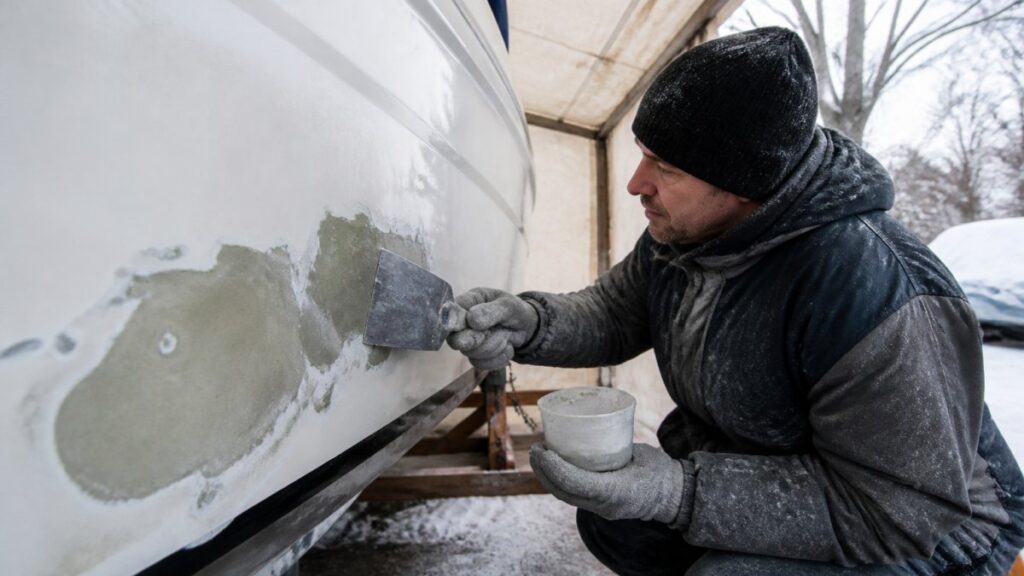
Yes, you can repair gel coat cold weather conditions, but temperature control is critical to success when you repair gel coat cold weather. Cold conditions slow the chemical reaction that hardens resin and catalyst, making curing unpredictable and incomplete. The real question isn’t whether it’s possible, it’s whether conditions are right for a repair that lasts.
The difference between a repair that holds and one that fails comes down to understanding how temperature affects the process.
Most DIY boaters underestimate how much temperature matters. A repair that cures perfectly at 70°F might stay tacky or brittle at 40°F, weakening adhesion and leaving the finish vulnerable to water intrusion and UV damage within weeks.
This guide covers minimum safe temperatures, work-area preparation, warming techniques, curing timelines, and a checklist to decide whether to repair or wait.
Minimum Temperature for Gelcoat Repair
Gel coat requires a minimum ambient temperature of 50°F to cure properly. Below this threshold, the chemical reaction between resin and hardener slows dramatically. At 40°F, curing times double or triple. At 32°F and below, the repair may never fully harden.
The surface temperature of the damaged area matters more than air temperature. A boat sitting in shade at 50°F air temperature might have a hull surface of only 40°F due to water contact and wind chill.
Professional shops typically won’t attempt gel coat work below 55°F without controlled heating, a margin that accounts for overnight drops below minimum thresholds.
Surface preparation is especially critical in cold conditions. A cold surface doesn’t accept gel coat as readily, the resin doesn’t flow smoothly, and adhesion suffers even if the repair eventually hardens.
Wind chill accelerates evaporative cooling: a 50°F day with steady wind can feel like 35°F on the hull, so sheltering your work area matters as much as air temperature.
Gel Coat Repair Preparation for Cold Conditions
Preparation in cold weather requires extra attention because every step affects how gel coat bonds and cures. Small nicks and scratches are more forgiving in cold conditions than deep cracks or holes.
Clean the damaged area with a degreaser to remove salt spray, oxidation, and contaminants. Cold surfaces hold moisture longer, so dry completely with compressed air or a lint-free cloth, trapped water prevents proper adhesion.
Sand the damage and surrounding area with 120-grit sandpaper. Create a slightly roughened surface that gel coat can grip.
Mask off the area with painter’s tape and plastic sheeting to protect surrounding gel coat, get clean edges, and contain drips that are harder to control in cold conditions. Styrene Thinner lowers viscosity for better application in cold weather environments.
Check your kit components. Cold thickens resin, and some hardeners work poorly below 60°F. Read the instructions, they should specify the minimum working temperature.
Warm your materials before mixing: place resin and hardener in a warm location for 30 minutes. Avoid heat guns or direct flame, gentle ambient warmth is safer, and warmed materials mix and flow better.
How to Warm Gel Coat for Repair Success
To repair gel coat cold weather successfully isn’t about heating the material itself, it’s about creating a warm work environment so the repair cures properly.
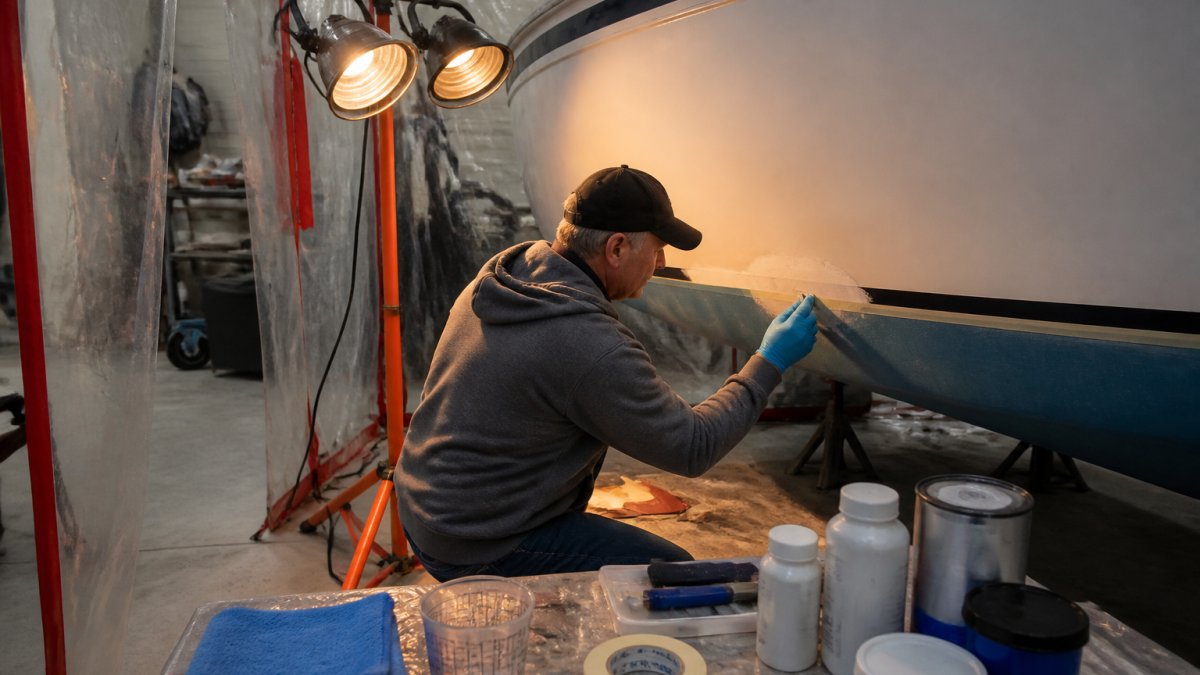
A heat lamp is the most practical tool for small repairs.
Never use open flame or high-intensity heat. Fiberglass can scorch or blister, and gel coat curing too fast creates internal stress that leads to cracking.
For larger repairs, build a temporary enclosure from plastic sheeting and duct tape, with a space heater or heat lamp inside.
Styrene thinner improves gel coat flow in cold conditions by lowering viscosity, but don’t over-thin. Patch Aid is specifically formulated to improve application and appearance in challenging temperature conditions.
Marine Coat One’s Patch Aid additive is specifically formulated to improve application and appearance in challenging temperature conditions.
Monitor temperature continuously. Check a thermometer near the repair every 15 minutes during application and the first hour of curing, increasing heat immediately if it drops below 55°F.
Gel Coat Curing Time in Cold Weather
Gel coat curing time extends significantly in cold weather. At 70°F, a typical repair reaches initial set in 4-6 hours. At 50°F, expect 12-16 hours for the same stage.
Initial set is when the gel coat stops being tacky, hard enough to sand but still fragile internally. This is not full cure.
Full cure typically takes 24-48 hours in warm conditions. In cold weather, budget 3-7 days for complete hardening. During this entire period, temperature must stay above 50°F.
Cold nights are the biggest threat.
Plan your repair for the warmest part of the day. Apply gel coat in the afternoon when surface temperature peaks.
Document curing time: mark the start time and date, and don’t sand or finish until you’re confident of full cure.
Specialty hardeners formulated for cold weather cure more reliably at low temperatures.
Curing time increases dramatically as temperature drops, and cold nights pose a serious risk to repair success.
| Temperature | Initial Set | Full Cure | Notes |
|---|---|---|---|
| 70°F | 4-6 hours | 24-48 hours | Ideal conditions |
| 50°F | 12-16 hours | 3-7 days | Minimum safe temperature |
| 40°F | 24+ hours | May not fully harden | Repair likely to fail |
| Below 32°F | Unpredictable | Never fully hardens | Do not attempt repair |
Cold-Weather Repair Go/No-Go Checklist
Before you start a gel coat repair in cold conditions, work through this checklist. If you answer “no” to any item, postpone the repair until conditions improve.
Temperature and Weather:
- Air temperature is at least 50°F (ideally 55°F or higher)
- Surface temperature is at least 50°F (use a thermometer to verify)
- Weather forecast shows temperatures staying above 50°F for the next 48 hours
- Wind speed is under 15 mph (or you can shelter the work area)
- No rain or high humidity expected during curing
Materials and Equipment:
- Your gel coat kit is rated for the current temperature
- You have a heat source ready (heat lamp, space heater, or heated shelter)
- You have a thermometer to monitor surface temperature
- You have Patch Aid or similar application additive if needed
- All materials have been warmed to room temperature
Repair Area:
- The damaged area is clean and dry
- Surrounding gel coat is sanded and roughened
- The repair zone is masked and protected
- You can maintain heat for at least 24 hours after application
Time and Commitment:
- You can dedicate the next 3-7 days to monitoring the repair
- You’re prepared to maintain heat overnight if temperatures drop
- You won’t need to move or use the boat during the curing period
Watch out: starting a repair when you can’t maintain temperature overnight is a common mistake, a single cold night can compromise the entire repair.
If three or more items are “no,” wait. Repairs done in marginal conditions often fail within weeks, forcing you to strip and redo the work.
Troubleshooting Failed Cold-Weather Repairs
Cold-weather repairs sometimes fail despite your best efforts. Common failures have specific causes and solutions.
Repair stays tacky or sticky after 48 hours.
This is the most common cold-weather failure.
Repair is hard but brittle or cracks easily.
Gel coat that cures too quickly in extreme cold becomes brittle and lacks flexibility. The internal stress causes micro-cracks.
Repair shows poor adhesion or peeling at edges.
The cold surface didn’t accept the gel coat properly, or the substrate was wet during application.
Color mismatch is more obvious in cold weather.
Cold gel coat looks slightly different in color and sheen than warm gel coat.
Repair cures unevenly with soft spots.
Temperature varied too much during curing, causing uneven hardening. Solution: This repair may be compromised.
The most important lesson: cold-weather repairs require patience and active temperature management. Rushing leads to failures that cost more than waiting for better conditions.
Ordering Your Cold-Weather Gel Coat Repair Kit
When you’re ready to repair gel coat in cold conditions, choose materials formulated to work in your temperature range. Marine Coat One offers gel coat & fiberglass repair kits formulated for the marine industry with hardener designed for low-temperature curing.
Look for kits with hardener designed for low-temperature curing. The Patch Paste Gel Coat Repair Kit is a complete kit with all components needed for cold weather application. Cold-weather hardeners initiate the cure reaction at lower temperatures.
Marine Coat One’s complete gel coat repair kits are engineered with factory-matched color and cold-weather performance in mind. Each kit includes resin, hardener, and application tools. The hardener formulation works reliably down to 50°F when proper warming techniques are used.
Consider adding Patch Aid additive to your order. This product improves gel coat flow and reduces cure time in cold conditions without requiring excessive thinning. It’s particularly valuable for cold-weather work where every advantage helps.
If your boat’s gel coat is more than 5-10 years old, color matching becomes critical. Older gel coat fades from UV exposure, and standard off-the-shelf colors rarely match. Marine Coat One offers custom color matching services to ensure your repair blends seamlessly with the existing hull.
Order materials well before you plan to repair. Cold-weather repairs can’t be rushed, and having everything on hand lets you wait for optimal conditions without scrambling for supplies.
Frequently Asked Questions
What temperature is too cold for gel coat repair?
Most gel coat repair kits require a minimum ambient temperature of 50°F and surface temperature of 55°F to cure properly. Below 50°F, the resin and hardener react too slowly, leading to incomplete curing, weak bonds, and surface defects. Surface temperature matters most, even if the air is 55°F, a cold boat hull absorbs heat from the water and may stay below the minimum threshold. Always check both readings before starting your repair.
How long does gel coat take to cure in cold weather?
In standard conditions (70°F), gel coat typically cures in 24 hours. In cold weather, curing time extends significantly, at 50°F, expect 48-72 hours or longer. Below 50°F, curing may stall entirely. Temperature directly controls the chemical reaction between resin and hardener; every 10°F drop roughly doubles curing time. Plan for extended downtime and do not sand or apply topcoats until the repair has fully hardened, even if the surface feels dry.
How can you keep gel coat warm while it cures?
Use a heat lamp positioned 12-18 inches above the repair, maintaining surface temperature between 65-75°F. Infrared heat lamps work best because they warm the surface directly. Avoid direct sunlight alone, it is unreliable in winter and can cause uneven curing. For outdoor repairs, build a simple wind barrier with cardboard or plastic sheeting to trap heat and block cold air. Never use an open flame or high-heat source; excessive heat causes bubbling and yellowing. A temperature gun confirms you are maintaining the target range.
Can you repair gel coat in cold weather if you prepare properly?
Yes, you can repair gel coat in cold weather if you follow strict preparation and temperature management. Assess your damage, confirm the ambient temperature is above 50°F, warm the hull surface to 55°F or higher, use a repair kit rated for cold conditions, and apply a heat source during curing. The key is controlling variables, surface preparation, material selection, and sustained warmth, that you cannot control outdoors in winter. Many professionals choose to wait for warmer months or move the boat indoors to avoid the complexity and risk of failure.
Cold-weather gel coat repair is challenging, but it’s entirely achievable with the right approach and materials. The key is respecting temperature limits, maintaining consistent warmth, and accepting longer curing times. Start with Marine Coat One’s cold-weather repair kits and additives, monitor temperature carefully, and you’ll restore your boat’s finish reliably even in the off-season.
